You've probably heard the claim that "a quarter of your home's heat escapes through the roof." It's repeated everywhere, and while the exact number depends on the property, the underlying point is real: heat rises, and an uninsulated or under-insulated loft is one of the most direct routes for it to leave your home. Here's what's actually going on, in plain English, and what makes a genuine difference versus what's marketing noise.
Why the roof specifically
Warm air is less dense than cold air, so it naturally rises within a room and presses upward against the ceiling and roof structure. In a home with poor loft insulation, that heat passes through the ceiling, into the loft space, and straight out through the roof covering into the open air. It's not that roofs are inherently "leaky" — it's simple physics: heat moves from warm to cold, and the path of least resistance in most UK homes is straight up.
What a U-value actually means
You'll see insulation products and building regulations referenced by their "U-value" — this is just a measure of how much heat passes through a material per square metre. The lower the U-value, the better the insulation. UK Building Regulations currently target a U-value of roughly 0.16 W/m²K for retrofit loft insulation (always check the current Approved Document L figures, as these get revised periodically) — in practical terms, this usually means around 270mm of mineral wool insulation, or the equivalent thickness in another material like rigid foam board or sheep's wool.
Most homes built before the 1990s were originally insulated to a much lower standard than that — often 100mm or less, if any insulation was fitted at all. If your loft insulation hasn't been touched since the house was built, there's a very good chance you're sitting well below the current recommended level, regardless of how new or old the roof covering itself is.
Loft insulation vs roof insulation — they're not the same thing
This trips a lot of people up. Loft insulation sits flat across the loft floor, between and over the ceiling joists — this is the standard, most cost-effective option for a loft that's just used for storage. Roof insulation follows the actual roofline itself, fitted between (and sometimes under) the rafters. It's more involved and more expensive, but it's the right approach when the loft space is being converted into a bedroom, office, or any other room you want to actually heat and use, because insulating the floor of a room you're now heating from below does nothing useful.
Does insulation help in summer too?
Yes, and this is often overlooked. Insulation slows heat transfer in both directions — it keeps heat out in summer just as it keeps heat in during winter. A well-insulated loft means a cooler house on a hot day, not just a warmer one in January.
The condensation question
A fair concern people raise: "won't sealing up the loft cause damp?" The honest answer is that insulation itself doesn't cause condensation — poor ventilation combined with insulation does. Warm, moist air from the house below still needs somewhere to go if it finds its way into the loft space, and if the loft isn't ventilated properly, that moisture can condense on cold surfaces like the underside of the roof covering or roofing felt. Any competent insulation job accounts for this — usually through eaves ventilation strips, roof vents, or a vapour control layer, depending on the specific setup. This is exactly why insulation is worth having installed properly rather than as a DIY afterthought: the insulation material itself is only half the job.
Breathable insulation — when it matters more
For older or solid-wall properties in particular, "breathable" insulation materials are increasingly the sensible choice. These allow moisture vapour to pass through the material rather than trapping it against timber roof structures, which matters most in period properties where damp management is already a bigger consideration than it is in a modern, well-ventilated new-build.
How quickly does it pay for itself?
This varies by property size, current insulation level, and energy prices at the time, but topping up loft insulation is consistently one of the highest-value home efficiency upgrades available — it typically pays for itself within a few years through reduced heating bills, and it keeps paying out every winter after that. It's also one of the more common ways to move a home's EPC rating up a band, which matters if you're planning to sell or remortgage.
One company, the whole picture
Because we do roofing and insulation, we can spot heat-loss problems while we're up there — and fix them properly, with the right ventilation to avoid condensation.
Explore loft insulation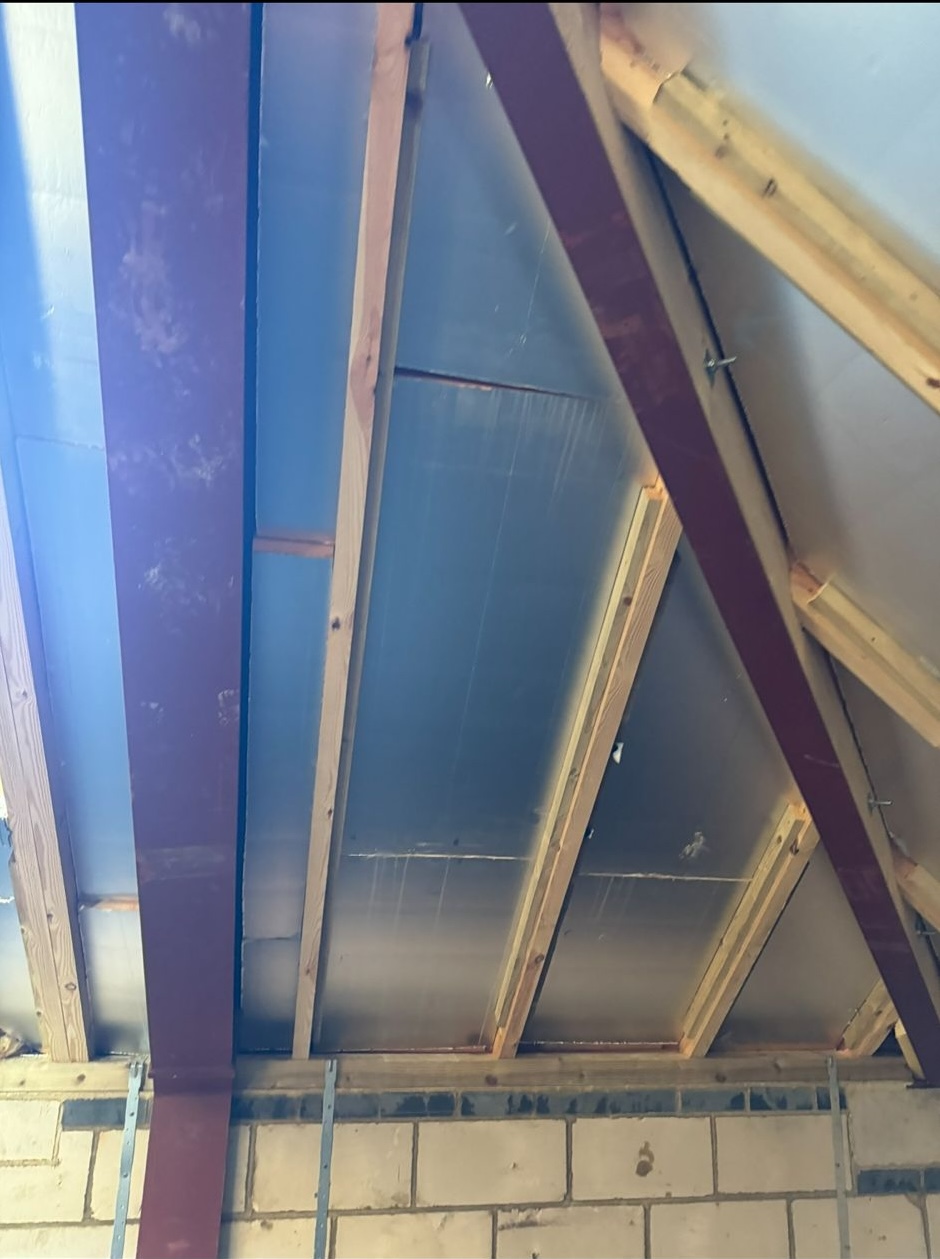
What we actually check on a survey
When we look at a loft for insulation purposes, we're checking: how much insulation is currently there (if any), what type, whether it's been compressed or displaced (loose-fill insulation especially tends to get kicked around if the loft's used for storage), whether ventilation at the eaves is clear, and whether the loft is being used purely for storage or is earmarked for conversion — because that changes whether loft insulation or full roof insulation is the right call.
- How much insulation is up there now, and what type
- Whether it's been compressed, flattened or displaced
- Whether eaves ventilation is clear
- Storage loft or future conversion — it changes the right approach
The bottom line
If your loft insulation predates current standards — or you're honestly not sure how much is up there — it's one of the easier, lower-disruption upgrades to check on. A short survey tells you exactly where you stand and what, if anything, is worth doing about it.